I was born in the Valley of Birds, just like my father. My mother, a Hummingbird flits around the yard, studio, classroom most days yearning for birds of San Francisco. Parrots of Telegraph Hill, great horned owls of Golden Gate Park, little round Presidio plovers, and feeders outside her Daly City window. Instead, she fills another jug of warm sugar water, cleans the feeders with a spiney bristle and waits for orioles on the patio.
Hummingbird's throat, they say, is red from carrying fire in her beak, bestowing humans with the gift of flame. There is a photo of my mother backpacking in Yosemite when she used to run with the rock climbers, before Royal Robbins started his clothing line. A red and black flannel curves over her shoulders. In summer she teaches watercolor to tourists in Yosemite Village and introduces her best friend, Judi to her future husband. Her front leg is poised to move. How rare it is, to find Hummingbird standing still.
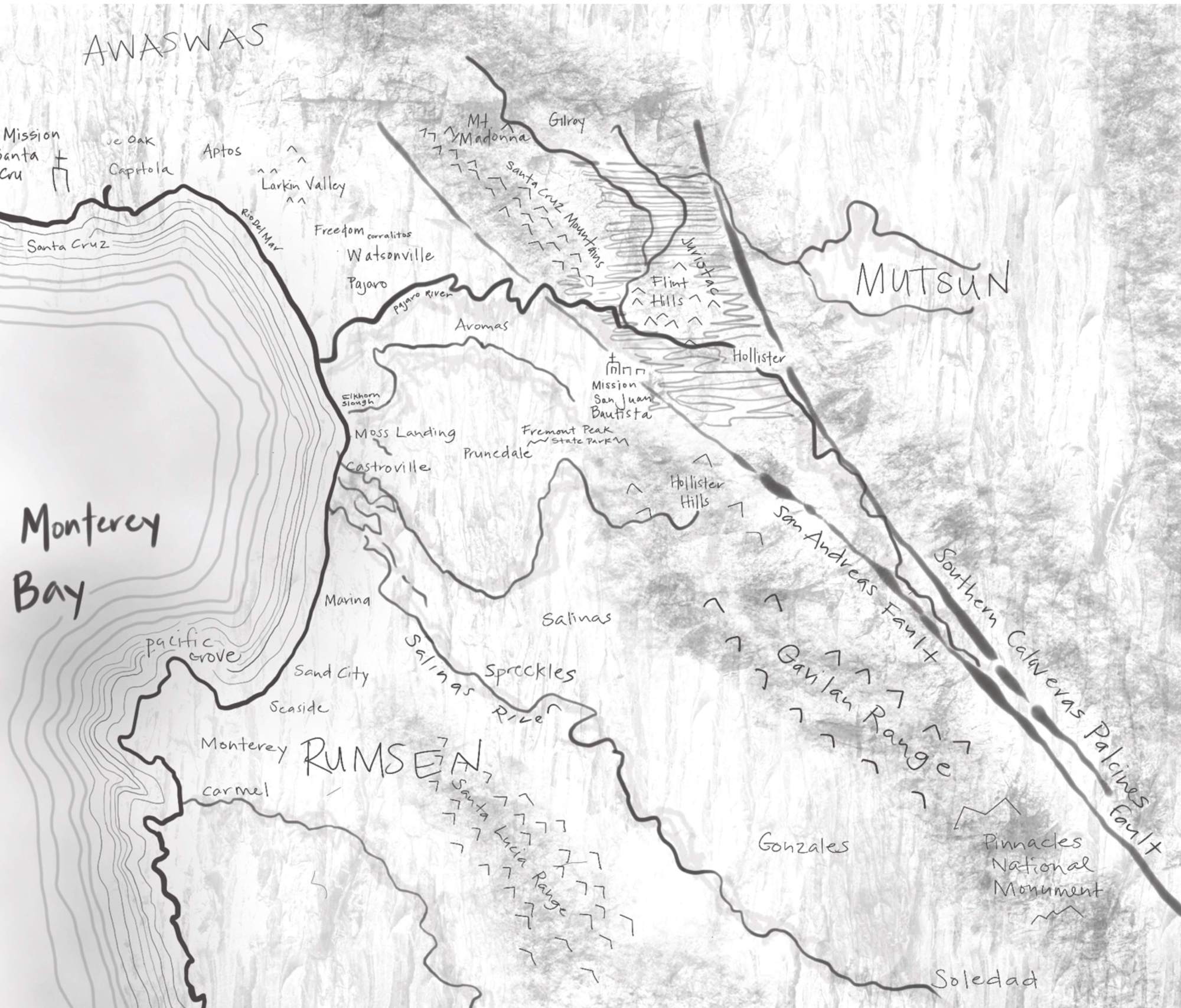
It is Hummingbird who tells Coyote how to impregnate the first woman after the flood recedes and the Ohlone return to the Valley of Birds. In fifth grade, we watch a video on tsunamis in Hawaii and plan evacuations to the highest local point: Mount Madonna. My parents and I take Emma and Dolores to the Mount Madonna Inn for dinner when they visit from Acoma to teach a workshop on traditional pit firing. Other times, riding down the mountain from Gilroy, we pull over the car into the narrow parking lot on top of Mount Madonna to watch the sun sink over the Valley of Birds, where my father and I were born Coyotes.
We watch the video a second time in sixth grade as my mother helps me sculpt a replica of King Tut's death mask because the only thing I know for sure is that I lived in the Valley of Kings at the end of the 18th Dynasty. My mother does not question my fascination with my past life in Ancient Egypt, brushing a pearly suspension of gold upon Tut's nose. My father is in the garage, wishing he were a bird.
After the great flood, Coyote repopulates the Valley of Birds. When the water recedes, a young girl stands in the sand and Eagle says, "You must father her children." Coyote had no idea how. Hummingbird says, "In the belly, of course!" The girl eats a louse off Coyote's fur and turns into a shrimp. Things don't work out with Coyote's first wife; when I am born, I have a sister. My sister is born just north of the Valley of Birds where the Ohlone flee to Fremont Peak during the great flood. My sister is born human, and Eagle says, "Welcome."
Like Joan Didion, my father marries his first wife at Mission San Juan Bautista to appease his Spanish Catholic family. Like my sister, they are human. He marries my mother some years later off a cement-cracked patio where feeders hang from several trees and my mother fashions bird baths in every shaft of sunlight. She and the birds of San Francisco get tipsy the night before off brandy soaked frosting. Stacking tiers of cake, they realize ceramicists are not bakers. My parents say their vows on patchy grass over the septic tank of the little red 1920's Sears Catalogue house with a paddock in back, in the unincorporated township Corralitos, meaning little corral in Spanish. Across the street cows, horses, and occasionally a llama greet us when we collect the mail. A single palm tree in the driveway marks which house is ours.
Before the flood, my parents live in a house built around a tree above the Soquel Creek which rises into a river when the great rains drive Coyote and Hummingbird to a little coral next to the Harvest Moon Market where Bazooka bubble gum will always cost a quarter. "This," they think, "is the place to raise a daughter."
Coyote is a trickster, which is why so many stories praise and defame him. His sleight of hand manifests magic from nothing. For a time, the paddock becomes a foundry and we cast little toys and machine parts out of piles of Pepsi cans while my mother weeds black widow spiders from the giant ceramic robot under the sycamore tree.
When he retires from thirty years teaching ceramics, my father buys a model T speedster with bucket seats and we cruise through Watsonville, Gilroy, all the way to Fremont Peak; bugs fill our teeth. There are so many old cars in the yard I lose count except two El Caminos under the walnut that bears the least amount fruit and the '32 Ford in the garage the color of rust we haul from Arizona when Randy is finally presumed dead. Randy was a back country ranger who gave me books on animal wildlife every year for Christmas. It took five years to find a single bone most likely gnawed by a bear. At his memorial in Sequoia, I buy a teddy bear at the gift shop and rub my thumb into his plastic nose. "The disturbance of bones means the spirits are not at rest," an Amah Mutsun man says when Ohlone bones are unearthed across Santa Cruz county. I search every book for a story of a bird born from a man's bone; all I find is Eve.
The first time we go to Acoma to visit Emma and Dolores I am nine. On the Mesa the tour guide says, "those who refused to carry wood up the mesa first lost a hand, and then a foot." I stare at the church ceiling thatched in hand-milled logs. On the floor, a mountain of hands and feet glow red against the votive stand. That night I get so sick, I worry I will die in Sky City New Mexico whose only bird is a clay parrot.
For many years after retirement the only clay my Father will touch is long coils fashioned into digeridoos that collect in the family room until he takes up flint knapping. He pounds stone with stone like Coyote pounds a six-legged man so flat he jumps on the back of a deer and becomes a tick.
What's always striking is the breadth of his abilities. In one story from the Northern Ute, Coyote fakes his own death and returns in a mountain lion skin to marry his daughter. His son gets suspicious when the mountain lion's teeth look just like his father's so their mother turns the family into stars and curses Coyote to solitude. In Navajo stories, Coyote creates the Milky Way out of impatience and is responsible for lunar phases. Sometimes, Coyote manifests havoc out of boredom.
Eventually, my father builds airplanes. Some the size of my mother's wingspan, some smaller. One day, while digging a trench in the back yard he says, "I always wish I'd been a pilot." In graduate school he makes ceramic hang gliders, now packed away in a shed. Coyote, always wants to be someone else, which is why he causes so much trouble.
In my thirties, I return to Sky City and ride the tour bus to the top of the mesa. For twenty years, the origin of Acoma's church is the only story I remember. A young woman gives the same speech—the hands, feet, and lives lost to the pueblo's largest building; a wooden crucifix so tall it reaches heaven. Above the door, I see a beautiful hand-painted rainbow. Above each window an animal or flower.
"The church décor represents both Catholicism and our earth traditions," the tour guide says pointing at the yellow sun above the rainbow. In some stories, Coyote, Eagle, and Hummingbird go away. Perhaps they grow old and die, or seek a new life beyond the Valley of Birds. Perhaps the represent a history we thought disappeared. Sometimes a new story rises from old bones.
One night in second grade, Hummingbird and Coyote take me to the jazz club for some family friendly folk only potters in plaid that smells like raku listen to. We run into Randy who's supposed to be in Yosemite. He's with a blonde woman I've never met. In The Last Season, Eric Blehm flourishes this scene, writing my mother "believes in fate," before she calls Judi to tell her of the affair. I flip through a copy of the book in the Ansel Adams Gallery in Yosemite Village. I rub my finger across my mother's name, yards from where she paints all the years before I'm born; I wonder if Hummingbird feels responsible for Coyote's first wife becoming a shrimp.
A friend tells me what she most admires about California shorebirds is their ability to coexist; their beaks divinely shaped to scavenge they don't need to compete with other species. A shore bird never wants to be another bird. In 1769 Portola and his men see a giant bird made of straw on the banks of the river and name it Pajaro as they cross into the Valley of Birds, Popeloutchom which stretches from Monterey to San Francisco. Less than a decade later, in the week of June that falls between my birthday and my father's, the adobe church at San Juan Bautista is built. Sometimes the devil himself appears in Coyote fur.
In Sedona, wind washes shards of pottery to the earth's surface. I collect them in my palm and run inside the house to show Coyote, Hummingbird, and Judi, before we haul the '32 Ford back to California. I never knew Randy was a writer despite Wallace Stegner suggesting he "try something else." His most famous work, a hand written note on the door of the ranger's station asked people to pack their trash. Writing is like the mountain and a ball of clay. Once it has touched you, there is no escape. Coyote had no idea how to repopulate the world, but knows he must try until he's succeeded or died. Randy's Christmas gifts, little books about racoons became a secret message between writers in the world of potters and birds.
One day, outside Mission San Juan Bautista where the cemetery is fenced from view, I lean against the locked gate and imagine all the Mutsun on the other side marked with a white-washed crucifix. My father talks to a guy about flint collecting expeditions. A rooster and three hens strut past, pecking bugs in the lawn. I stare at my hands, each line carving a mountain, valley, and word. I decide I no longer want to be a Coyote.
When the flood covers the shore of Central California, Eagle carries Coyote and Hummingbird to the top of Fremont Peak, to begin the world anew. "The least I owe these mountains is a body," one of Randy's journal reads. The Park Service reports Randy likely fell through a snow drift and was swept into a waterfall. When Aristotle said birds transfigure into other species when the seasons change, I knew the opposite to be true. The next day I was born an eagle.